
Takeoff Software Risks Before You Sign a Contract
Guide to know how software errors happen, how they distort bid leveling, and what a general contractor should verify before committing.
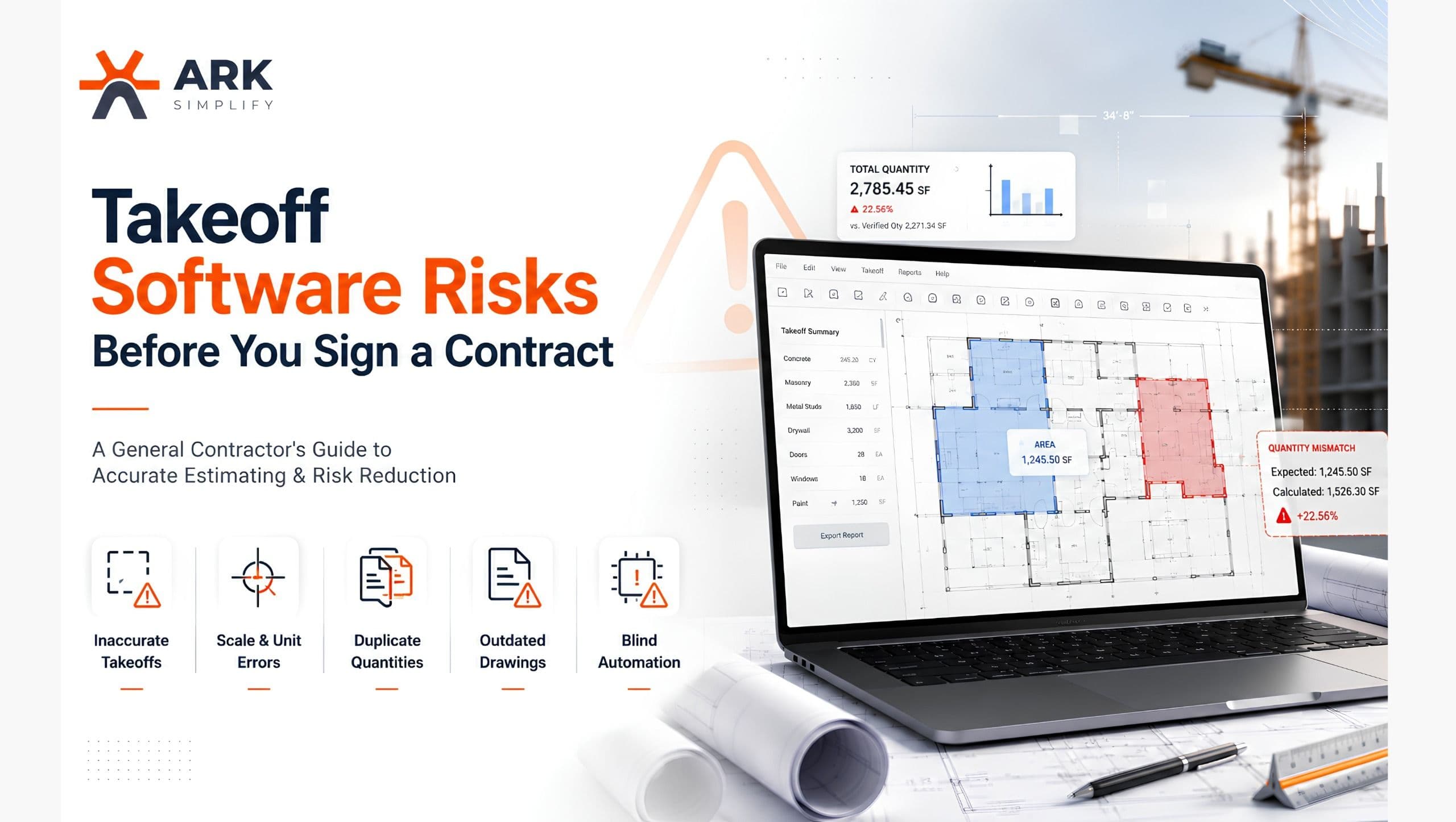
Quick answer: Takeoff software is only as reliable as the quantity analysis behind it. Before you sign any estimating vendor contract, you need to know how software errors happen, how they distort bid leveling, and what a general contractor should verify before committing. This guide walks through each risk in plain language, with a pre-contract checklist at the end.
Why Takeoff Software Risk Deserves Your Attention
Every estimate starts with a takeoff. A takeoff is simply the process of measuring a project's drawings to work out how much material, labor, and equipment a job will need. In the industry, this is called quantity analysis, and it is the foundation of every number that follows—cost, schedule, and profit.
The problem is that takeoff software does not remove human judgment; it changes where the judgment happens. A tool can miscount a wall, misread a scaled drawing, or double-count a shared area between two rooms. If nobody catches the error before the bid goes out, the mistake travels straight into the final price.
For general contractors, this is not a small technical detail. A flawed quantity analysis can turn a profitable job into a loss, or worse, cost you a contract you should have won.
Top Takeoff Software Risks General Contractors Should Know
Before signing any estimating vendor contract, it helps to understand exactly where takeoff software tends to go wrong.
- Scale and unit errors — A drawing loaded at the wrong scale will produce quantities that look reasonable but are completely off.
- Overlapping or duplicate counts — Automated tools can count the same item twice if drawings have overlapping layers or repeated symbols.
- Outdated drawing versions — Software pulls numbers from whatever file it is given. If that file is not the latest addendum, the entire estimate is built on old information.
- Blind trust in automation — digital counts are a starting point, not a finished answer. Treating them as final without a manual spot check is one of the most common and costly mistakes in the industry.
- Poor data handoff between systems — When takeoff data moves from one software platform to another (for pricing, for bid leveling, or for project management), formatting errors can quietly change quantities along the way.
None of these risks mean takeoff software is a bad idea. They mean it needs a trained eye reviewing the output, not just a program running in the background.
How Software Errors Disrupt Bid Leveling
Once a takeoff is complete, most estimating teams move into **bid leveling** — the process of comparing subcontractor and vendor bids side by side to make sure everyone priced the same scope of work.
Leveling bids only works if the baseline quantities are accurate. If the original takeoff overstated or understated a quantity, every comparison built on top of it inherits the same error. A subcontractor's price might look high or low simply because the scope they were given did not match reality.
This is why bid leveling should never be treated as a purely clerical task. It is a second checkpoint where a careless takeoff error can either be caught — or locked in permanently.
From Estimate to Contract: What to Verify Before You Sign
Whether you run a small operation or a large commercial construction contractors firm, the questions to ask before signing an estimating vendor contract stay largely the same.
A few things worth confirming upfront:
- Who reviews the software's output? Ask whether a licensed or experienced estimator checks automated counts or whether the numbers go straight from software to bid.
- How are revisions handled?Drawings change mid-project. Confirm how quickly the vendor updates a takeoff when addenda are issued.
- What is the accuracy track record? A general construction contractor or general construction company should be comfortable asking for sample accuracy rates or references.
- Is the contract flexible or locked in long-term? Long-term estimating vendor contracts can be efficient, but only if the vendor's error rate stays low. Ask about exit terms before you need them.
These questions apply whether you are a solo general contractor bidding a handful of jobs a year or a larger firm running multiple estimating services at once.
What Is a Bid Bond, and Where Does It Fit In?
What is a bid bond?
A bid bond is a guarantee, usually issued by a surety company, that a contractor will honor the terms of their bid if awarded the project — and that they can secure a performance bond to complete the work. It protects the project owner from a contractor walking away after winning a bid or submitting a bid they cannot actually deliver on.
Here is where takeoff accuracy connects directly to the bid bond: a bond is only as sound as the estimate behind it. If a flawed quantity analysis produces an unrealistically low bid, a contractor may win the job and then struggle to deliver at that price. This is one of the quieter but more serious consequences of unchecked takeoff software risk—it does not just affect one estimate; it can affect your bonding capacity and reputation over time.
Why Estimating Services Alone Aren't Enough
A strong takeoff is the starting point, not the finish line. Getting the numbers right is only valuable if the project is then managed well from award to completion.
This is where estimating services need to connect to project management services. A few distinctions worth knowing:
- Operational project management covers the day-to-day coordination of resources, schedules, and site activity once a job is underway.
- Project execution refers to the phase where the plan built during estimating and pre-construction is actually carried out in the field.
- Construction project management focuses specifically on managing the building process—sequencing trades, tracking progress, and controlling cost against the original estimate.
- Engineering project management applies a similar discipline to technical and design-heavy phases of a project, often working alongside the construction team rather than replacing it.
In practice, construction and project management work best as a connected process, not two separate departments that hand off a file and stop talking. The tighter the link between project management and construction management, the less likely an early takeoff error is to snowball into a budget overrun months later.
Pre Contract Checklist: Before You Sign an Estimating Vendor Contract
Use this as a quick reference before committing to any takeoff or estimating partner:
- Confirm a human estimator reviews all automated takeoff output
- Ask how quickly quantity analysis is updated after drawing revisions
- Request sample accuracy data or client references
- Clarify how bid leveling is handled if multiple vendors are involved
- Understand how estimating accuracy could affect your bid bond and bonding capacity
- Check whether the vendor also supports project management services, or only hands off a static estimate
- Review contract length and exit terms before signing
Frequently Asked Questions
What is quantity analysis in construction?
Quantity analysis, commonly called a takeoff, is the process of measuring project drawings to determine the materials, labor, and equipment a job will require. It is the first step in building a cost estimate.
What is bid leveling?
Bid leveling is the process of comparing multiple bids for the same scope of work to ensure they are priced on equal terms, so a contractor can make an accurate, apples-to-apples decision.
What is a bid bond?
A bid bond is a financial guarantee that a contractor will accept a contract if awarded and can obtain the required performance bond. It protects project owners if a low bidder cannot follow through.
Can takeoff software replace a human estimator?
No. Software can speed up measurement and counting, but it cannot judge context, catch outdated drawings, or apply field experience the way a trained estimator can. The safest approach combines both.
The Bottom Line
Takeoff software risk is not a reason to avoid automation — it is a reason to pair it with review. Whether you are a general contractor comparing estimating vendors, or a commercial construction contractors firm evaluating a long-term partnership, the questions are the same: who checks the numbers, how are changes handled, and how does the estimate connect to what happens after the contract is signed.
Getting this right protects more than one bid. It protects your bonding capacity, your bid leveling process, and ultimately, your reputation on the next project.
Looking for estimating services that pair software speed with expert review?
[Talk to Ark Simplify about a takeoff and estimating partnership built for general contractors who can't afford costly errors.]